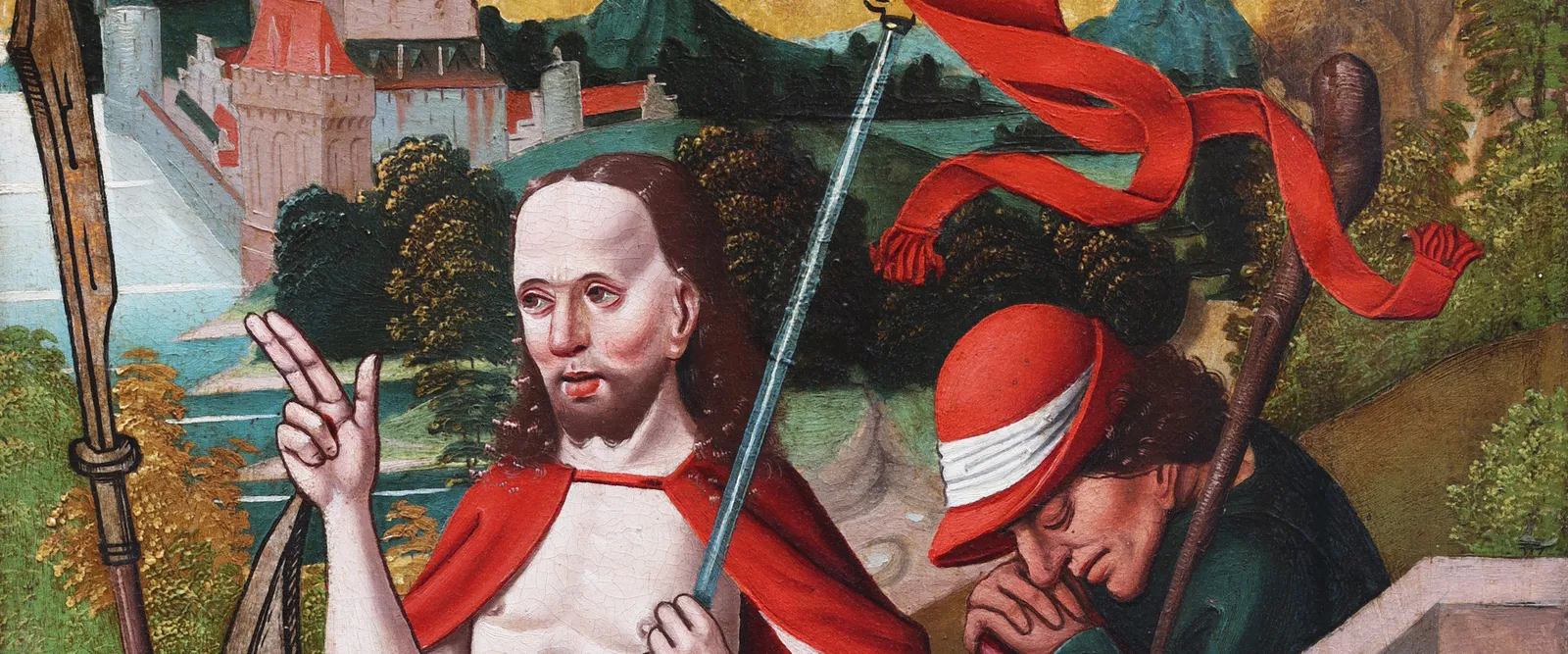
Around 1500, an anonymous painter working in the vibrant artistic centre of Lübeck created this dramatic sequence of Passion scenes for a large church altarpiece. Today he is known as the Master of the Reval Legend of Saint Elizabeth—a name derived from his most famous work, a cycle of paintings illustrating the life of Saint Elizabeth in the Church of the Holy Spirit in Tallinn (historically Reval), Estonia. Though his true identity remains unknown, art historians believe he worked closely with the celebrated Lübeck artist Bernt Notke, one of northern Europe’s leading painters and sculptors around 1500. These four monumental panels once formed the wings of a much larger altarpiece illustrating the final days of Christ’s life. In late-medieval churches, such wings could be opened or closed depending on the liturgical calendar, revealing different sequences of images. Here, twelve episodes from the Passion unfold like a visual drama, guiding viewers step by step through betrayal, suffering, death, and resurrection.

When the altarpiece was closed, the outer wings introduced the story. At the upper left appears the Last Supper, where Christ announces that one of the apostles will betray him. Opposite is the Arrest in the Garden of Gethsemane, when Judas identifies Christ with a kiss and soldiers move in to seize him. Beneath these scenes are Christ before King Herod and the brutal Flagellation, where Christ is tied to a column and tormented by his captors. Opening the wings reveals a dazzling interior where eight further Passion scenes unfold against shimmering gold backgrounds. The sequence begins with Ecce Homo and progresses across the upper register through the Road to Calvary, Christ being nailed to the Cross, and the Crucifixion. Beneath these, the drama moves toward its resolution: the Descent from the Cross, the Entombment, Christ’s triumphant Descent into Limbo, and finally the Resurrection, where the risen Christ emerges victorious from the tomb. The scenes' gilded backgrounds and clear compositions ensured that they could be easily read and understood even from a distance.

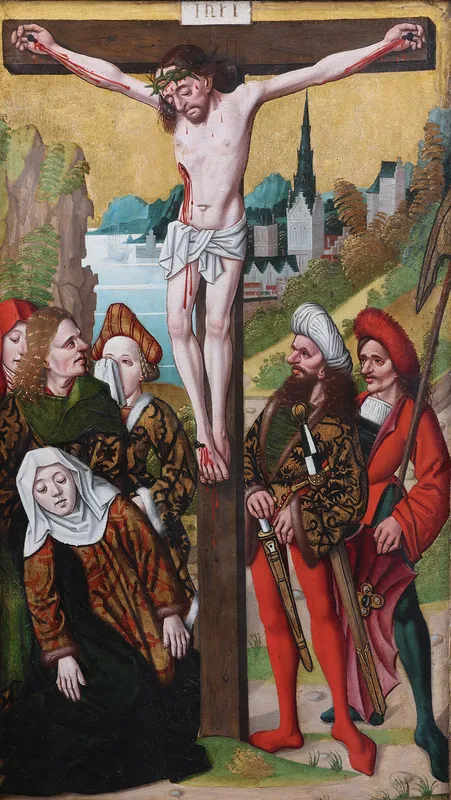
Stylistically, these magnificent paintings reveal a painter deeply engaged with the visual culture of his time. Some scenes draw inspiration from popular prints circulating across Europe—for example, the Ecce Homo composition adapts an engraving by the renowned German printmaker Martin Schongauer. Yet our artist also freely modified his sources, simplifying and sharpening the imagery to make the story vivid and legible for a wide audience.
Together, these panels capture the powerful storytelling at the heart of late-medieval altarpieces: works designed not just to decorate sacred spaces, but to immerse worshippers in the unfolding drama of the Passion and be activated through the Liturgy. With bold colour, expressive figures, and carefully staged narrative moments, the Master of the Reval Legend of Saint Elizabeth transformed theology into compelling visual theatre.


Provenance
- Baron Swansea (1875-1934), Caer Beris, Builth Wells, Wales
- With Edward Speelman (1910-1994), London, from whom acquired by
- Fischer, Lucerne, 12th April 1956, from whom acquired by
- John and Johanna Bass, New York, 27 August 1958
- By whom bequeathed to the Bass Museum of Art, Miami Beach, in 1963 (inv. no. 1963.020)
- Deaccessioned and sold at Sotheby’s New York, ‘Property of The Bass, Miami Beach to benefit the John and Johanna Bass Art Acquisition Fund’, 6th February 2025, lot 303
Published
- Deuxième Exposition de Tableaux Anciens de grands Maitres, Exh. Cat., Geneva, 1957, pp. 38-41, cat. no. 18, reproduced.
- A. Stange, Kritisches Verzeichnis der deutschen Tafelbilder vor Dürer, Vol. I, Munich, 1967, pp. 210-211, cat. no. 685.
- The John and Johanna Bass Collection at Miami Beach, Miami, 1973, cat. no. 20.
- M. Russell, in Paintings and Textiles of the Bass Museum of Art: Selections from the Collection, Miami Beach, 1990, p. 56, reproduced.


